The historical account of the conquest of Jericho, as described in the sixth chapter of Joshua, is testimony to the faith and obedience of Israel under the leadership of Joshua. Jericho was the most fortified city in the region of Canaan. The city was about seven acres in entirety, but well protected among all cities in Canaan. If Jericho is defeated, all other cities will be smaller, less fortified, and easy to conquer. Israel will get a sense of accomplishment and will move forward in inheriting the Promised Land. The sense of accomplishment would give a boost to the morale of the army and the confidence of the people in their leader, Joshua.
Unbelief and Rebellion
God chose Joshua to succeed Moses and to lead the Israelites into the Promised Land. The Nation had to suffer for forty years in the wilderness, when the older generation who rebelled, disobeyed, and disbelieved had perished (Numbers 14:34). The delay of forty years in possessing the Promised Land was unbelief and rebellion. The next generation under Joshua, who had witnessed the rebellion, would lead the Nation to possess the Land.
The Promise
Perhaps, Joshua wondered how he could lead the nation, that had a short, but turbulent, and rebellious history. God assures Joshua that He will grant the victory. The city was fortified, on high alert, and fully closed. The Jericho city people thought they were safe and secure. On the other side they had a fear, that was expressed by Rahab to the spies. God of Israel has done mighty things for the nation. (Joshua 2:10) But the Lord told Joshua that Israel had victory and the city belonged to them.
Eyes of faith
The Gift of Faith is to see what is invisible and beyond the present time frame. God challenges his people to see with the eyes of faith.
See with insight: God challenged Joshua to see the victory with the eyes of faith. “See, I have given Jericho into your hand, with its king and mighty men of valor “(Joshua 6:2). With his physical eyes, he was seeing the fortified walls, watch towers, huge gates, and also armed men patrolling the walls. The spies who went to the city of Jericho, protected by Rahab, also described the fortifications to Joshua. It was an intimidating structure for the Israelites, who had spent forty years in the wilderness. Putting off all these from his mind, Joshua had to see the victory promised.
Promise of God: Eyes of faith see the future, based on the Promise of God. Joshua should rekindle his faith, as he stood with Caleb, encouraging people to possess the Land. Sadly, people rebelled then. (Number 13:30) Will people rebel again and revolt against Joshua? The Promise of God gave assurance to Joshua that such internal strife would not happen.
Plan of God: The Plan of God is like a whole picture. This picture is broken into small puzzle pieces. Each promise is like a puzzle piece. Only God could bring up the pieces to complete the final picture.
Clear vision: Eyes of faith could see with clarity. There were concerns about Israel’s ability to conquer Jericho. They have not become experts in war. There were doubts, and Joshua could give excuses. Similarly, when the Lord commanded His disciples to ‘look at the field,’ or ‘lift your eyes and see.’ (John 4:35) Eyes of faith could see that the harvest is ripe and ready for harvest. Without faith, the disciples could give excuses that the time had not come, or it was not ripe.
Purpose: Eyes of faith could see the purpose. God is Sovereign over the history and geography of this world. He uses individuals, families, communities, and nations to fulfill His ultimate purpose of redeeming the world and judging Satan and the wicked. With the eyes of faith, a believer could know and grasp God’s perspective.
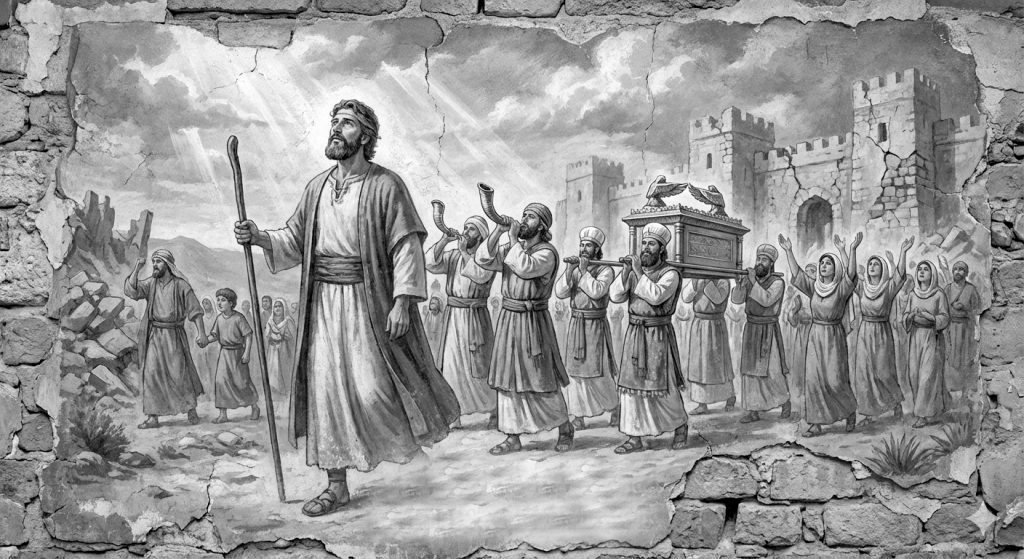
Time: Eyes of faith could see that the time had come for God to fulfill the promise. Joshua had to begin preparation of his priests to carry the Ark of the Covenant, blow trumpets, while soldiers marched in front and at the back of the procession.
Protection: Eyes of faith could see the invisible protection. Elisha was surrounded by angels in the chariots of fire, which his servant could not see. (II Kings 6:17) People of God are protected as they fulfill God’s will. Yes, there could be sufferings allowed by God, that would be for God’s higher purposes.
Obedient Steps
Faith in action is obedience. Joshua cannot be passive and dormant to receive the promises. Trusting God’s word, there should be faith in action.
Faith in action
Joshua must believe in God and his promises. First is his personal faith. The Promised Land has been promised to the Nation of Israel. Now, God has promised to deliver the city of Jericho to Israel as the beginning of the conquest of Canaan. He has to take the leadership mantle, strategize, communicate, and mobilize to inherit the promise.
Second, Joshua should share this Promise of God with the elders of the people. They also should believe in the Promise of God. Earlier, when Joshua and Caleb gave the report as spies exploring the Promised Land, the people had rejected. Then there are commanders of the army belonging to various tribes. They should believe in the Promise and be willing to accept the strategy given by God. Sadly, in many churches and organizations, the second line of leadership lacks the faith, vision, and enthusiasm of the leader. Such ministries may stagnate and gradually decay.
Third, there was a greater challenge for the Nation of Israel, believing in the promise of god, as well as the strategy revealed by god to Joshua.
New Strategy
The length of the march around the city was about one km. It was not a great strategy, and did not make any military sense. Generally, in ancient times, they used two strategies to conquer fortified cities. First, it was to dig beneath the walls and climb the walls, and attack the city. Second, the city was besieged, cutting the supply of water, food, and other essentials. Thus, to make the city surrender. Neither of the strategies was used. God gave a different strategy.
Joshua was able to understand the strategy, share it with his leaders, and organize the march for the seven days. He was able to communicate, convince, and mobilized them for the march of victory.
You shall march
The march was around the city. The marching procession had soldiers in the front and back. In the middle was the Ark of the Covenant carried by the Priests. (Joshua 6:9) The seven priests would blow the seven ram horns, but the people and soldiers should observe silence as they marched. They were to be silent until the seventh day when Joshua would call them to shout.
Seventh day
On the seventh day, they marched seven times around the city. After the seventh march, Joshua commanded the people to shout as the priests blew the trumpet. People shouted and rushed straight and conquered the city. They put to the sword all living things, including men, women, and children. Only Rahab and her household were spared. All spoils were devoted unto the Lord.
God could have made the city flat, without Israel doing anything. He could have sent an earthquake. However, God wants to engage His people as His co-workers to fulfill His plan and purpose. God is magnanimous to get humans involved and give them rewards too.
Ark of the Covenant
In this incident, the Ark of the Covenant is mentioned eleven times. That becomes the central aspect of the whole narrative. The march with the Ark of the Covenant was an opportunity given to the people of Jericho to repent. The Israelite also should remember the covenant, especially the Ten Commandments. The Covenant without commandments and promises cannot qualify as a covenant. The march was not a religious ritual, but a remembrance of God’s faithfulness, His commandments, and promises. It was the sacred duty of the Priests to carry the ark, symbolizing the Presence of God in their midst.
Challenge
The historical incident teaches lessons on faith and obedience. God’s promises have to be received in faith. God expected the leader Joshua, the elders, the military commanders, and all Israel to be receptive. Promises not only received in faith, but the obedience should be demonstrated. Joshua and Israel acted on the Promise and strategy given by God, with diligence. Promise became reality by faith and obedience. Let us examine if we receive promises of God in faith and obey the commandments that are conditions of that promise?