
This article presents a layered study of the Red Sea and Jordan River crossings, highlighting their enduring significance in the New Testament, particularly concerning baptism, ecclesial identity, and the believer’s spiritual journey in Christ.
The crossing of the Red Sea, as recorded in Exodus 14, marks a pivotal moment in Israel’s salvation history. Set against the backdrop of their deliverance from Egypt, this event signifies the nation’s liberation from bondage and the beginning of their covenantal journey. By divine intervention, the waters of the sea are miraculously parted, allowing Israel to pass through on dry ground—a passage that embodies both protection and promise. In contrast, Egypt’s pursuing army is overwhelmed and destroyed, sealing Israel’s release and initiating their pilgrimage through the wilderness under God’s guidance.
The crossing of the Jordan River, as narrated in Joshua 3, marks Israel’s long-awaited entrance into the Promised Land after forty years of wilderness wandering. This moment unfolds as the priests, bearing the Ark of the Covenant, step into the river’s edge—whereupon the waters miraculously cease, allowing the people to cross on dry ground. Unlike the Red Sea, which symbolized deliverance from bondage, the Jordan represents transition into inheritance. With this passage, Israel begins its conquest of Canaan, stepping into the fulfillment of divine promise and the establishment of covenantal life within the land.
The Red Sea and Jordan River crossings, though distinct in historical context, form a theological arc that traces Israel’s journey from bondage to inheritance. Each event is marked by divine intervention, yet their directional movement and typological significance differ in profound ways.
The Red Sea crossing, led by Moses, signifies Israel’s deliverance from slavery in Egypt. The waters, divided by the prophet’s rod, represent a passage out of bondage and into the wilderness—a liminal space of testing and transformation. Typologically, this crossing prefigures death to the old life, and in New Testament reflection, it aligns with baptism into Christ’s death (cf. Romans 6:3–4; 1 Corinthians 10:2).
In contrast, the Jordan River crossing, under the leadership of Joshua and the Ark of the Covenant, marks Israel’s entrance into the Promised Land. Here, the waters are halted by the feet of the priests, emphasizing the presence of God as the true guide. This movement into promise typologically represents resurrection life, and in Christian theology, it echoes baptism as entrance into new creation and spiritual inheritance (cf. Colossians 2:12; Hebrews 4:1–11).
The bondage of Israel in Egypt serves as a type of humanity’s enslavement to sin, as Paul affirms in Romans 6:6. Their passage through the parted waters of the Red Sea—led by Moses and sustained by divine intervention—mirrors the believer’s death with Christ, enacted sacramentally through baptism (Romans 6:3–4). Just as Pharaoh’s army was overwhelmed and destroyed in the sea, so too are the powers of sin and Satan disarmed through Christ’s victory on the cross (Colossians 2:15).
Paul makes this typological connection explicit: “All were baptized into Moses in the cloud and the sea” (1 Corinthians 10:2). In this statement, the apostle frames Israel’s deliverance as a corporate baptism, a shadow of the Church’s passage through the waters of death into new life. The Red Sea thus becomes not only a historical threshold but a sacramental archetype—where divine judgment and mercy converge, and the journey of redemption begins.
In contrast to the Red Sea’s typology of death and deliverance, the Jordan River crossing in Joshua 3–4 serves as a rich symbol of resurrection and inheritance. After forty years of wilderness wandering, Israel’s passage into Canaan marks not only the fulfillment of promise but the beginning of life in the Spirit. As Paul writes, “There is now no condemnation for those who are in Christ Jesus…who walk not according to the flesh but according to the Spirit” (Romans 8:1–4). The movement through the Jordan thus mirrors the believer’s entrance into the new life of grace.
The Ark of the Covenant, borne by priests and leading the procession, typologically points to Christ as the forerunner—He who enters the heavenly sanctuary on our behalf (Hebrews 6:20). Just as the Ark halted the waters and made a way, so Christ opens the path into the inheritance of the saints.
Following the crossing, twelve stones are set up as a memorial—a visible sign of Israel’s new identity as a covenant people in the land. This act echoes forward into Revelation’s vision of the New Jerusalem, where twelve names of the tribes and apostles adorn the foundations and gates (Joshua 4:9; cf. Revelation 21:12–14). The stones thus serve not only as historical markers but as typological emblems of ecclesial identity, rooted in divine promise and fulfilled in Christ.
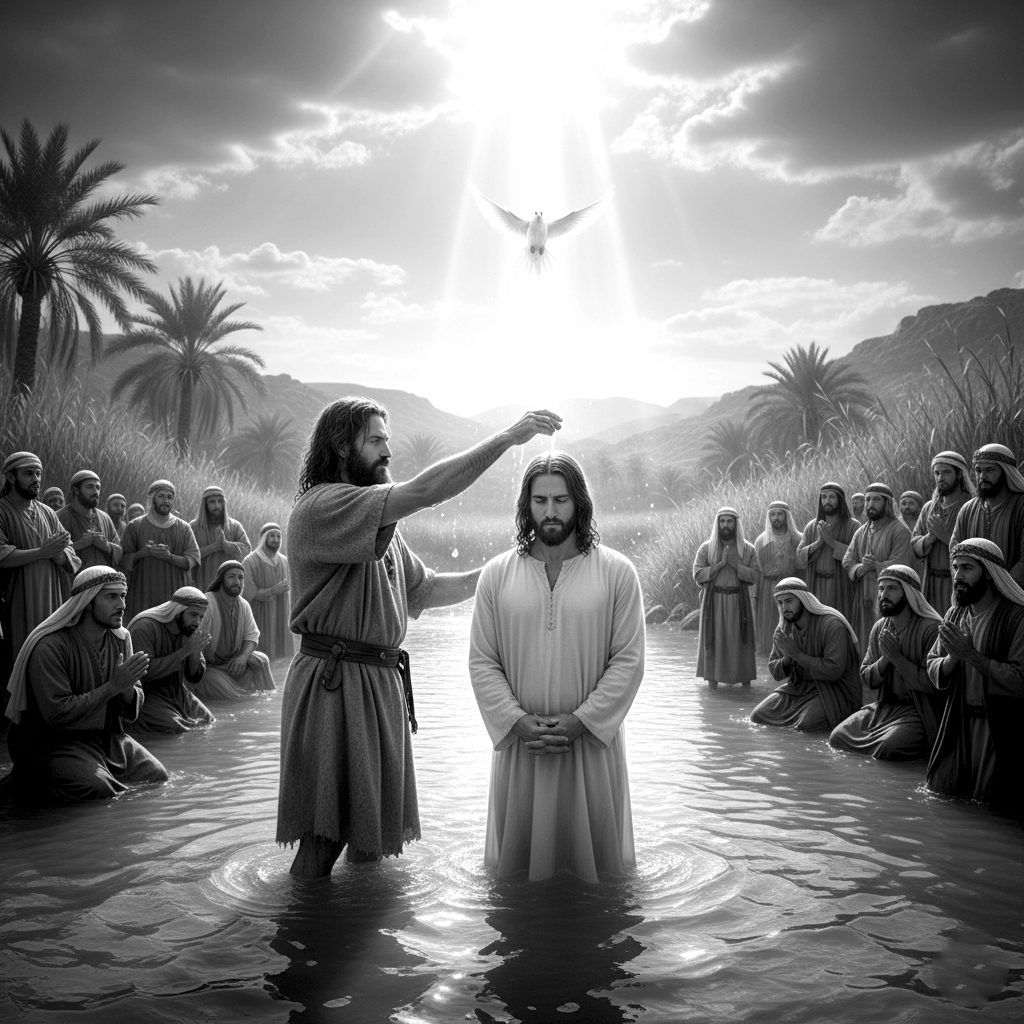
The Jordan River reaches its fullest typological expression in the baptism of Jesus, recorded in Matthew 3:13–17. Here, the waters that once parted for Israel now receive the incarnate Son of God, who descends into them not for purification, but to sanctify the waters themselves. This moment inaugurates His public ministry and reveals the triune mystery: the heavens open, the Spirit descends like a dove, and the Father’s voice declares, “This is my beloved Son.”
In this act, Jesus stands as the true Joshua—whose very name, Yeshua, echoes the Old Testament deliverer—leading not into a temporal land, but into the Kingdom of God. The Jordan thus becomes a threshold not merely of geography, but of eschatology: a passage from the old creation into the new, from prophetic anticipation into messianic fulfillment.
By entering the Jordan, Christ identifies with humanity’s need for redemption and prefigures the baptismal path by which believers follow Him into death, resurrection, and Spirit-filled life. The river that once marked Israel’s inheritance now flows with grace, inviting all who are in Christ to cross into the promises of God.
Paul’s reflection in 1 Corinthians 10:1–4 draws baptismal imagery from this event, interpreting Israel’s passage through the sea as a corporate baptism “into Moses.” This typological reading frames the Red Sea as a sacramental archetype: the waters become both grave and gateway, signifying death to the old life and entrance into covenantal identity. Theologically, the crossing prefigures Christian baptism, where the believer is united with Christ in His death and raised to walk in newness of life.
The crossing of the Jordan River in Joshua 3:14–17 is marked by priestly mediation and divine presence. As the priests bearing the Ark of the Covenant step into the waters, the river halts—signifying that it is not human strength but the presence of God that opens the way. The Ark, emblematic of God’s throne and covenantal faithfulness, leads the procession, affirming that
Israel’s entrance into the land is a sacred act of fulfillment, not mere conquest. This moment realizes the promise given to Abraham: “To your offspring I will give this land” (Genesis 12:7). The Jordan crossing thus becomes a liturgical enactment of covenantal inheritance, where divine fidelity meets human obedience at the threshold of promise.
Romans 6:3–4 draws a baptismal parallel: “We were buried therefore with him by baptism into death…” Just as Israel passed through the waters into new life in the land, so the believer enters the waters of baptism to die with Christ and rise into resurrection life.
Hebrews 4:1–11 interprets the Promised Land typologically as Sabbath rest. The Jordan crossing becomes a figure of entering divine rest—a rest not merely of geography, but of grace, where the believer ceases from striving and abides in the finished work of Christ.
These echoes affirm that the Jordan is not only a historical river but a theological symbol—where promise, presence, and passage converge in Christ. It invites the Church to see baptism as both fulfillment and beginning: the entry into inheritance, rest, and mission.
The typological significance of the Red Sea and Jordan River crossings finds rich expression in the liturgical and ecclesial life of the Church. Early Church Fathers such as Cyril of Jerusalem and Ambrose of Milan interpreted these events as paradigms of Christian baptism. The Red Sea, in their view, symbolized death to sin—where the old self is drowned and the enslaving powers are vanquished. The Jordan, by contrast, represented entrance into new life, echoing the believer’s resurrection in Christ and the beginning of Spirit-led vocation.
Ecclesiologically, these crossings frame the Church as the new Israel, journeying from bondage to promise. Just as Israel was led by the presence of God through parted seas and halted rivers, so the Church is led by Christ through the waters of baptism into the inheritance of grace. The pilgrim people of God, marked by sacramental passage, are called to live as those who have crossed from death into life, from exile into communion, from wilderness into worship.
The crossings of the Red Sea and the Jordan River are far more than historical episodes—they are spiritual archetypes that continue to shape the Church’s understanding of baptism, discipleship, and divine calling. These events invite believers to perceive baptism not merely as a ritual act, but as participation in a cosmic drama: a passage through death into life, through judgment into grace, through exile into communion.
In the Red Sea, the believer is called to die to the old self, leaving behind the bondage of sin and the tyranny of spiritual Egypt. In Jordan, the baptized enters into resurrection life, stepping into the inheritance of the Spirit and the mission of the Church. Together, these crossings frame the Christian life as a sacred journey: from Egypt (sin), through the wilderness (sanctification), into Canaan (communion and vocation).
This typological path is not only doctrinally rich but pastorally vital. It reminds the Church that baptism is both beginning and becoming—a threshold into identity and a summons into pilgrimage. As the waters part and the Spirit leads, the people of God are invited to walk forward in faith, bearing the memory of deliverance and the hope of promise.
This article offers a richly layered study of the Red Sea and Jordan River crossings to illuminate their New Testament significance. Drawing from Scripture, it explores how these events prefigure Christian baptism, ecclesial identity, and the believer’s spiritual journey. Framed as both historical thresholds and spiritual archetypes, the crossings invite the Church to see baptism not merely as initiation, but as participation in the drama of redemption—from bondage to promise, from death to resurrection.